Michael Munje
PhD student · UT Austin CS · LARG
I am a fourth-year PhD student at UT Austin, advised by Peter Stone in the Learning Agents Research Group (LARG). I study how robots and other learning agents can learn from human behavior and feedback and act effectively alongside them through continuous interactions.
Before UT, I completed an M.S. in Computer Science at Georgia Tech and received my B.S. in Computer Science from California State University, Northridge. Previously, I have interned with the ML group at NASA JPL, where I worked on detecting fresh impact craters on Mars, Microsoft (three times, optimizing advertising systems), and IBM Research (quantization for large language models). I am a regular reviewer for conferences such as NeurIPS, CVPR, AAMAS, RSS, ICRA, and CoRL.
Outside of research I enjoy playing guitar, piano, and running.
michaelmunje [at] utexas [dot] edu · CV · Bio · Google Scholar · GitHub

Research
My research focuses on developing autonomous agents that can learn from and interact effectively with humans. I am particularly interested in how agents can understand human behavior, learn from the different ways people provide feedback, and adapt through interactions. Much of my current research uses social robot navigation as a domain to study these problems.
My research is guided by three main research questions:
- RQ1How can agents learn to understand and model human behavior? Human behavior is complex and depends on the environment and interactions with others. How can agents learn representations and predictive models of human behavior from real-world observations and use them to inform decision-making?
- RQ2How can agents learn from the different ways humans teach and provide feedback? Humans learn from various forms of guidance and feedback, such as demonstrations, verbal feedback, and implicit signals like facial reactions. How can agents interpret and incorporate these diverse signals into their learning process?
- RQ3How can agents adapt to individual humans? Human behavior and preferences can vary across individuals and environments and may change over time. How can agents learn individual preferences, adapt to these differences, and continually improve their behavior through interactions with humans?
Selected publications
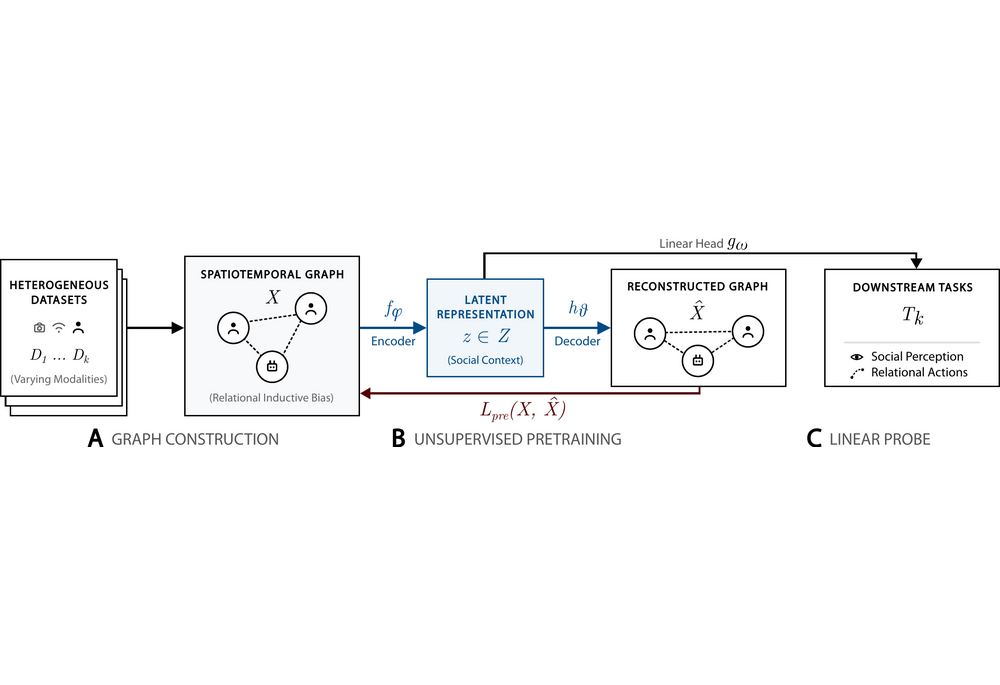
A self-supervised graph autoencoder that compresses short multi-agent interactions into compact social representations, which are strong and label-efficient for social perception and pedestrian action prediction.
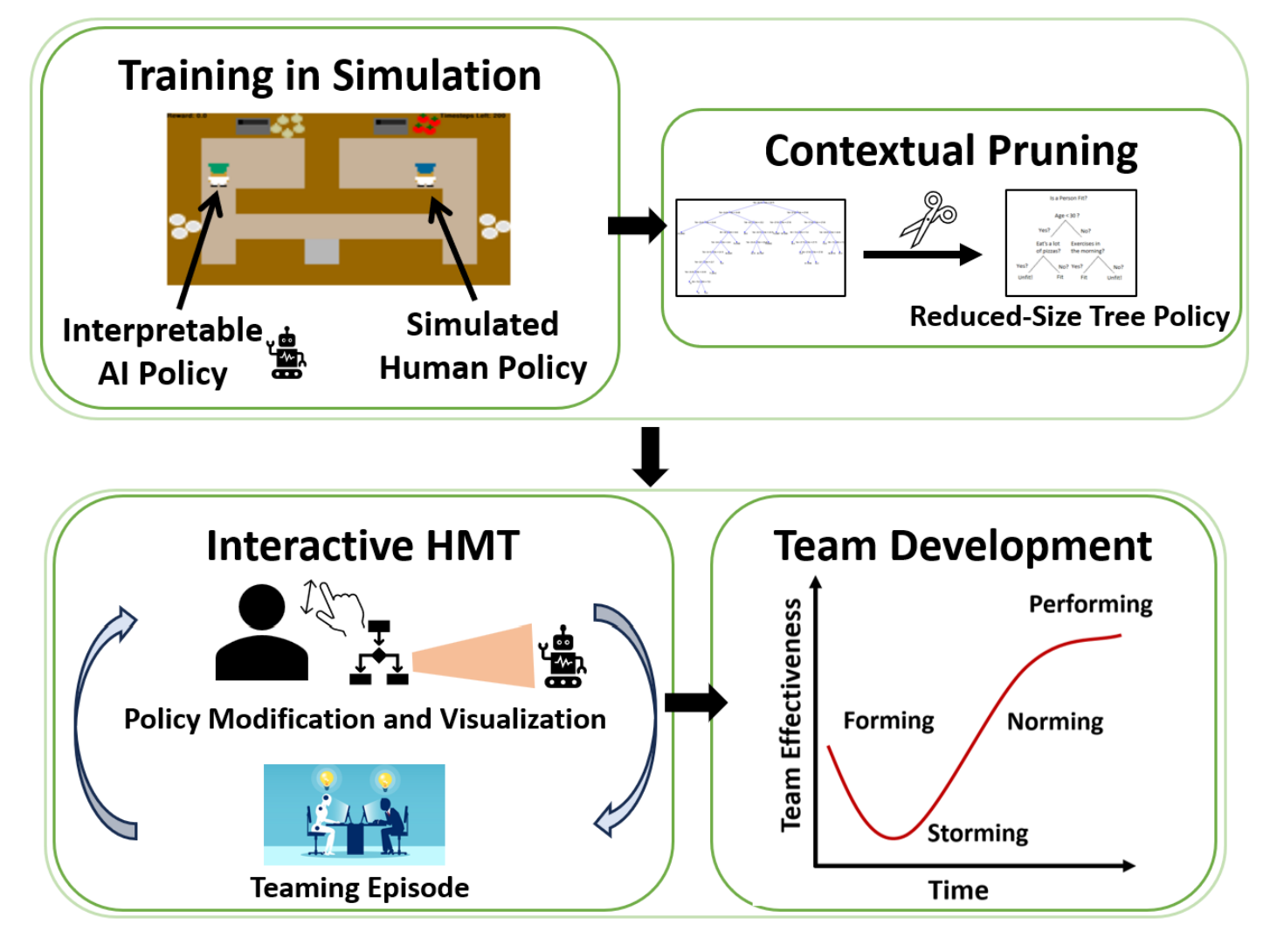
An interactive, interpretable policy-learning platform that lets people shape their AI teammates, leading to more fluent human-AI teamwork than black-box approaches.
All publications
A self-supervised graph autoencoder that compresses short multi-agent interactions into compact social representations, which are strong and label-efficient for social perception and pedestrian action prediction.
A VQA benchmark showing that today's best VLMs still trail simple rule-based and human baselines at spatial, spatiotemporal, and social reasoning in real robot navigation scenes.
A diffusion policy that learns navigation motion primitives separately and composes them at deployment to follow multi-part instructions like “overtake while staying right.”
Simulator-Guided Importance Sampling combines open-box simulation with importance sampling to tune large-scale ad recommenders more accurately and at lower cost.
An interactive, interpretable policy-learning platform that lets people shape their AI teammates, leading to more fluent human-AI teamwork than black-box approaches.
Robot air hockey as a reinforcement learning testbed for dynamic manipulation, with multiple simulators of increasing fidelity.
A crater-detection model deployed across nearly the entire surface of Mars that reduces observational bias and found many previously unknown new impacts.
A challenge suite of tasks for collaboration among multiple humans and multiple robots using voice and gestures.
Giving a human-machine team theory-of-mind predictions of an adversary's movements improves their teaming performance.
A VQA benchmark showing that today's best VLMs still trail simple rule-based and human baselines at spatial, spatiotemporal, and social reasoning in real robot navigation scenes.